Pages

Showing posts with label free pattern. Show all posts

Free Knitting Pattern: Triangle Rib Baby Hat by Heidi Gustad

This month, we're pleased to feature Heidi Gustad of Hands Occupied, who shares a FREE baby hat knitting pattern for our Fall/Winter Charity KCAL! Knit one, two or a whole bunch of little hats babies in need; you can contact your local hospital to inquire about current needs and requirements, or send your donations to Wool Aid, where they will be given to those who need them most.

Heidi is a knitting, crochet and crafts Designer and former Librarian. She first learned to knit at age 8 from a grandmother who saw in her a need for something to keep her busy. Her obsession with primary colors and clean lines can be seen throughout her work. You can keep up with her designs and more by following her blog and searching your favorite social network for handsoccupied. Don’t forget to share your finished knits online with #handsoccupied and #kpcharityKCAL.

Keep reading for KAL details, including your chance to win some great prizes from Knitter's Pride! 

free knitting pattern - triangle rib baby hat

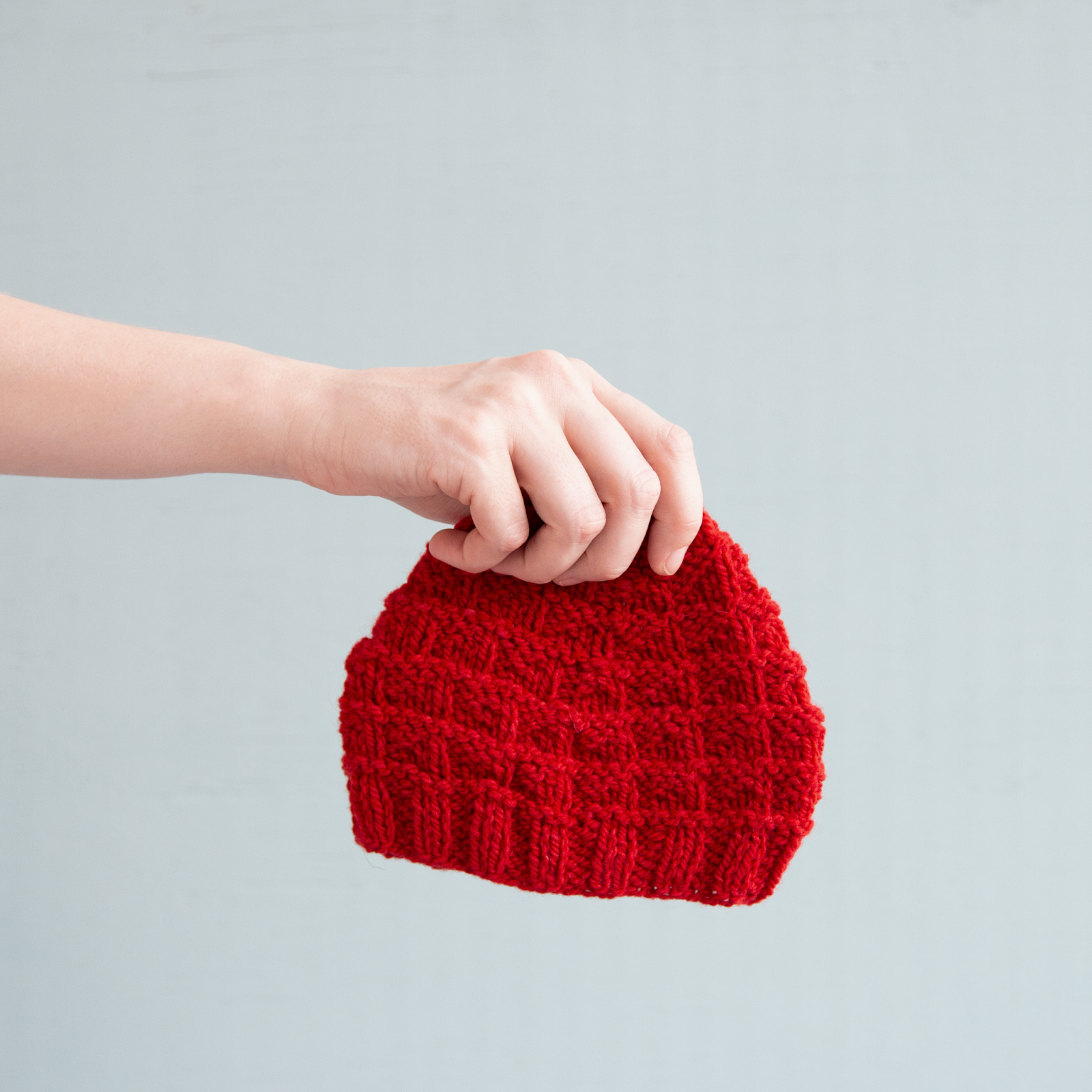
Triangle Rib Baby Hat by Heidi Gustad

YARN

Shepherd’s Lamb Rambouillet Yarn (100% Organic Wool; Sport Weight) in Razzleberry

NEEDLES

US 5 (3.75 mm) double pointed or appropriate circular needles

NOTIONS


FINISHED SIZE

Hat measures 13” (33 cm) from in circumference and 5.5“ (14 cm) in height.

GAUGE

approx. 18 sts and 28 rows = 4” [10 cm]

Abbreviations

( ) repeat instructions as indicated between the parenthesis
CO cast on
sts stitches
rnd round
k knit
k2tog knit 2 sts together
p purl
p2tog purl 2 sts together
rep repeat
rep from * to end repeat instructions following the asterisk as directed
free knitting pattern - triangle rib baby hat

Pattern

CO 60 sts (or any multiple of 4 sts) using a German twisted cast on for stretch and sturdiness.

rnd 1. *k2, p2; rep from * to end of rnd.

rnds 2-6. Rep rnd 1.

rnd 7. p all sts.

rnd 8. k all sts.

rnd 9. *k3, p1; rep from * to end of rnd.

rnd 10. Rep rnd 1.

rnd 11. *k1, p3; rep from * to end of rnd.

rnd 12. p all sts.

rnds 13-15. Rep rnds 9-11.

rnd 16. *p13, p2tog; rep from * to end of rnd. (56 sts)

rnd 17. *k12, k2tog; rep from * to end of rnd. (52 sts)

rnds 18–20. Rep rnds 9-11.

rnd 21. *p11, p2tog; rep from * to end of rnd. (48 sts)

rnd 22. *k10, k2tog; rep from * to end of rnd. (44 sts)

rnds 23-25. Rep rnds 9-11.

rnd 26. *p9, p2tog; rep from * to end of rnd. (40 sts)

rnd 27. *k8, k2tog; rep from * to end of rnd. (36 sts)

rnds 28-30. Rep rnds 9-11.

rnd 31. *p7, p2tog; rep from * to end of rnd. (32 sts)

rnd 32. *k6, k2tog; rep from * to end of rnd. (28 sts)

rnds 33-35. Rep rnds 9-11.

rnd 36. *(p1, p2tog) twice, p1; rep from * to end of rnd. (20 sts)

rnd 37. *k2, k2tog; rep from * to end of rnd. (15 sts)

rnd 38. *k1, k2tog; rep from * to end of rnd. (10 sts)

rnd 39. *k2tog; rep from * to end of rnd. (5 sts)

Finishing

Break yarn and draw tail through final loops to secure. Tighten to bind off.

For a PDF version of this pattern, visit handsoccupied.com.


Fall/Winter Charity KCAL with Knitter's Pride

Knit or crochet your favorite baby hat pattern (or use the one on this post!) to donate to your local hospital or those in need via Wool Aid; click here for more ideas on finding places where your handmade hats are needed! 
Share your finished hat photos here in our Ravelry group, or post them on Facebook or Instagram using the #KPCharityKCAL hashtag to be entered in our prize drawing: 2 lucky winners will get a Rainbow Row Counter Ring from our new collection!

ANY baby hat finished between November 22, 2019 - January 5, 2020 will be eligible in our prize drawing. We will notify the winners via direct message after January 5. We can't wait to see all of your knitted and crocheted hats! 

Like this post? Pin it!
Free Knitting Pattern: Triangle Rib Baby Hat by Heidi Gustad

Free Pattern: Tadley's Diagonal Blanket

Today we have a free crochet blanket pattern from designer Marie Segares, the Underground Crafter. Marie Segares has been hooked on crochet since she learned from her grandmother when she was 9. She conquered her fear of knitting in 2010. In addition to designing, Marie teaches both crochet and knitting in the New York City metro area and at regional fiber events. She is a Professional member of the Crochet Guild of America and a Designer/Teacher member of The Knitting Guild Association. Marie always appreciates visitors to her blog, Underground Crafter, where she shares her crafty adventures, along with interviews, book reviews, and giveaways.

I love crocheting baby blankets. They work up quickly (in comparison to adult blankets!) and are usually cherished by new parents and babies alike! When one of my dearest friends was expecting her first child, I knew I had to crochet something special.

I decided to use double-ended crochet because it looks great – but different – on both sides. And, to combat the love-hate relationship I develop with all of my crocheted blankets during the last few rows, I decided to crochet this on the bias, increasing towards the center and then decreasing until the end. After you reach the center point, each row is shorter than the one before it!

This blanket is very lush and thick, and works equally well as a playmat in the spring or a stroller blanket in the winter. Gauge isn’t critical, and it can be easily resized (though you may need more or less yarn).

Choose a flexible double-ended crochet hook, like one created from the Knitter’s Pride Dreamz Interchangeable Tunisian/Afghan Crochet Hook Set or the Knitter’s Pride Bamboo Interchangeable Tunisian/Afghan Crochet Hook Set. If you don’t have two Tunisian hooks in the same size, you can always switch the positions of the hook and end cap at the beginning of each row where you slide loops and turn.


Free Pattern: Tadley’s Diagonal Blanket by Marie Segares


Finished Size
Adjustable. Photographed sample is 36” (91.5 cm) square.

Materials
• King Cole Merino Blend Aran (100% superwash wool, 1.75 oz/50 g/88 yd/80 m) – 10 skeins each in Denim 778 (CA) and in Aran 776 (CB), or approximately 840-1,000 yd (770-915 m) in each of 2 colors in any medium/worsted weight yarn.
• I/9 5.5 mm flexible double-ended crochet hook, or size needed to obtain gauge.
• Yarn needle.

Gauge
18 sts x 18 rows in Tss = 4” (10 cm). Exact gauge is not critical for this project.
Abbreviations
CA = color A
CB = color B
ch = chain
ea = each
rep = repeat
Rnd(s) = Round(s)
sc = single crochet
sk = skip
sp = space
st(s) = sts
Tfs = Tunisian full stitch (used to increase 1 st in this pattern) = Insert hook under horizontal bar (between 2 vertical bars), yo and draw up loop onto hook.
Tss = Tunisian single stitch = Insert hook under next vertical bar, yo and draw up loop onto hook.
Tss2tog = Tunisian simple stitch 2 together (used to decrease 1 st in this pattern) = Insert hook under next 2 vertical bars, yo and draw up loop onto hook.

Pattern notes:
• Always sk first vertical bar (below first loop on hook) at beginning of row. 
• Blanket is crocheted in rows on the bias, increasing to the center and then decreasing to end. Border is crocheted in the round.
• Weaving in ends in double-ended crochet projects can be challenging. Change colors at beginning or end of rows when possible.
• For edging, a stitch marker or piece of scrap yarn can be used to indicate corner st.

Pattern Instructions

Blanket

With CA, ch 3.

Set Up Row: Sk 1st ch. (Insert hook in next ch, yo and pull up a loop) twice. (3 loops)

Increase stitch count to center
Row 1: Slide loops to other hook, turn. With CB, ch 1, *yo and draw through 2 loops. 
Rep from * across.

Row 2: Tfs in first sp between vertical bars, Tss in each vertical bar across to last sp, 
Tfs, Tss in last st. (Increase by 2 sts)

Row 3: Slide loops to other hook, turn. With CA, ch 1, *yo and draw through 2 loops. 
Rep from * across.

Row 4: Rep Row 2.

Rep Rows 1-4 until sides measures approximately 34”/86 cm (or desired length), ending after Row 3.

Decrease stitch count to end
Row 5: Tss2tog, Tss in ea vertical bar across to last 3 sts, Tss2tog, Tss in last st. (Decrease by 2 sts)

Row 6: Rep Row 1.

Row 7: Rep Row 5.

Row 8: Rep Row 3.

Rep Rows 5-8 until 3 sts remain on hook, ending after Row 3.

Final Row: With CB, (insert hook in next vertical bar as for Tss, yo, draw through both loops on hook) twice. Fasten off.

Edging

Rnd 1: Facing side where CA is more prominent, join CB with a sc in corner, 2 sc in same st, *sc in edge st of ea row across to next corner,** 3 sc in corner; rep from * around twice, then from * to ** once. Fasten off.

Rnd 2: Turn, facing side where CB is more prominent, join CA with sc in corner st, 2 sc in same st, *sc in each st around to next corner,** 3 sc in corner; rep from * around twice, then from * to ** once. Fasten off.

Rnd 3: Turn, facing side where CA is more prominent, join CB with sc in corner st, 2 sc in same st, *sc in each st around to next corner,** 3 sc in corner; rep from * around twice, then from * to ** once. Fasten off.

Rnd 4: Rep Rnd 2. 

Finishing
With yarn needle, weave in ends.

Giveaway

This month we're giving away Waves Crochet Hooks in size I/9 (5.5 mm) to two lucky winners! To
enter leave a comment on this post telling us about your last crochet project. Don't forget to tell us your Ravelry ID so we can contact you if you're one of the lucky winners! 


Free Spring Pattern + A Giveaway

We're excited to share with you a great pattern for showing off your knitting skills all spring and summer long! Today we're sharing another free pattern from designer Mari Chiba from Mari Knits. Mari had these thoughts to share with us about her new design:

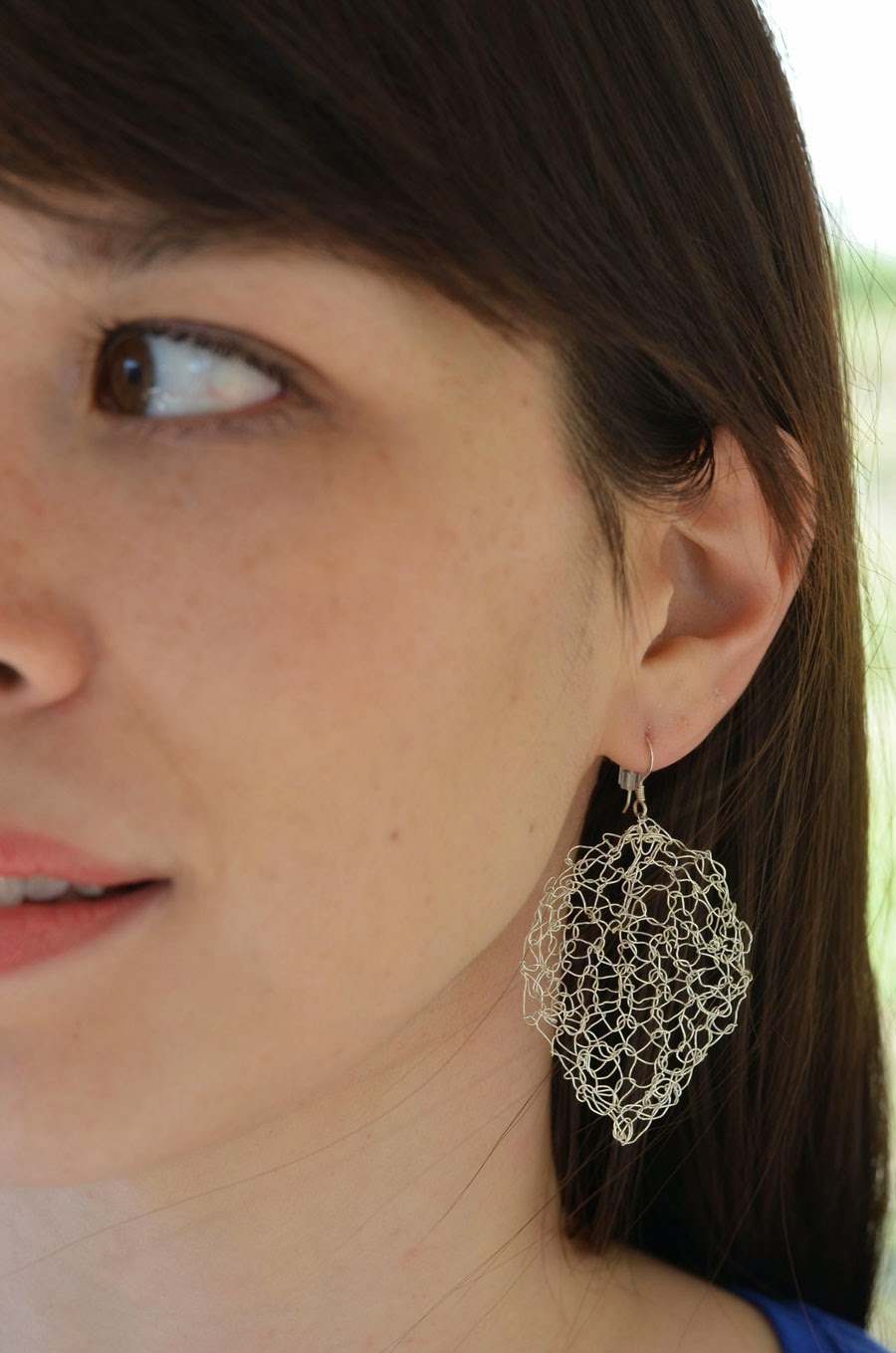
These beautiful silver earrings are worked with 32 gauge pure silver wire on Knitter's Pride Bamboo
DPNs. I prefer knitting with bamboo needles when working with silver because it helps grip the metal better. You could use straight or circular needles for this project, but since you're working such a small number of stitches I find that double pointed needles are easier to hold and manage while knitting. I used US 4 (3.5mm) needles for these earrings, but if you'd like a more open weave to your earrings you could use US 5 (3.75mm) or us 6 (4mm) needles. This will also result in a slightly larger earring.

Materials
US 4 (3.5 mm) double pointed knitting needles (see note above)
2 Silver Earring Wires

25 yards 32 gauge silver wire

Abbreviations
CO     cast on
k2tog  knit 2 stitches together 
k         knit
skp     slip 1 knit-wise , k1, pass the slipped stitch over
st(s)    stitch(es)

Leaf Earring (make 2)
CO 3 sts. 
Row 1: K1, yo, k1, yo, k1; 5 sts. 
Row 2, 4, 6: Knit. 
Row 3: K2, yo, k1, yo, k2; 7 sts.  
Row 5: K3, yo, k1, yo, k3; 9 sts. 
Row 7: K4, yo, k1, yo, k4; 11 sts. 
Rows 8-10: Knit. 
Row 11: K1, skp, k5, k2tog, k1; 9 sts. 
Rows 12-13: Knit. 
Row 14: K1, skp, k3, k2tog, k1; 7 sts. 
Rows 15-16: Knit. 
Row 17: K1, skp, k1, k2tog, k1; 5 sts. 
Row 18: Knit. 
Row 19: Skp, k1, k2tog; 3 sts. 
Row 20: Skp, k1; 2 sts. 
Row 21: Skp; 1 st. 
Cut wire and pull through the last stitch. 

Finishing
Using the tail from the cast on attach the earring to the earring wire. Weave in the end through the body of the earring and trim. Weave in the end from the tip of the leave and trim. Shape the earring as desired. 

Giveaway

This month we're giving away three pairs of Knitter's Pride Karbonz Fixed Circular needles to three lucky readers! With smooth nickel tips, a strong lightweight carbon fiber body and flexible cords these needles are great for all types of projects!

For your chance to win, leave a comment on this blog telling us what makes you a strong and flexible knitter or crocheter. Don't forget to mention your Ravelry ID so we can get in touch with you if you're one of our three lucky winners! We'll be announcing the winners on Friday, April 25, 2014

Winner + Free Exclusive Pattern from Rohn Strong!

Today we welcome knit and crochet designer Rohn Strong to be our guest on the Knitter's Pride blog. Rohn not only shares his thoughts on one of his favorite techniques - Tunisian Crochet - he also has designed a fun, free pattern that's great for beginners! We hope you enjoy today's guest post and look forward to seeing your projects here in the Knitter's Pride Ravelry group!

I adore Tunisian Crochet. So much so, in fact, that most of my recent designs are focused on this wonderful technique. What is Tunisian Crochet, you ask? Well, Tunisian Crochet (sometimes referred to as Afghan Crochet) is a crochet technique which uses a longer than normal hook that is sometimes cabled. Tunisian crochet is the best of both worlds: the look of knitting with the ease of crochet.

I get asked all the time, "Why Tunisian Crochet? Why don’t you just knit? Why don’t you just stick to crochet?" I love knitting, but let’s face it…it takes a long time! I also love crochet, but sometimes it can be a bit rigid and bulky. Tunisian Crochet is a great way to solve these issues; with the right hook to yarn ratio (it is a bit different than what traditional crochet calls for) you can get a garment that looks and feels like knitting but without the huge time investment! Trust me, it is wonderful for last minute gifting.

Left: Dreamz Tunisian Crochet Hook Set
Right: Bamboo Single-Ended Crochet Hook
To get you started on your Tunisian Crochet journey, I have designed a pattern that is both simple and stunning. It takes just one skein of Cephalopod Yarns Beastie in the colorway Ogopogo, and you don’t even need a Tunisian Crochet hook -  just a regular crochet hook without a pronounced thumb rest will do. This is also called an inline hook, and the Knitter's Pride Basix Birch, Bamboo, or Dreamz hooks will work quite nicely for you. Of course, a great option is to just purchase a Tunisian Crochet Set, which includes 8 hooks.

PATTERN INFO 

These simple but stunning fingerless mitts are perfect for those last few weeks of winter. They take just a few hours to make up and are a perfect intro to Tunisian Crochet!

MEASUREMENTS
 7.5”/18.75cm in circumference. 8.5”/21.25cm in length.

MATERIALS

  • 1 Skein - Cephalopod Yarns Beastie (60% Superwash Merino/30 % Alpaca/10% Tussah silk) 4oz/140yds 
  • US J (6.0mm) Crochet Hook 
  • Tapestry Needle 

GAUGE 14 sts and 6.5 rows = 4”/10cm over Tunisian Double Crochet (Tdc) using size J/10 (6.0mm) crochet hook.  *Take Time to Check Gauge* 

NOTES 

  • Mitts are made in one piece from side to side. The foundation chain and last row are then joined to close. 
  • Be sure to use a yarn with a bit of animal fiber in it, as Tunisian Double Crochet has the tendency to lean to one side a bit. This can be counteracted simply by blocking. 
  • Because only a small number of loops are held on the hook at one time, a Tunisian Crochet Hook or standard crochet hook with an inline shaft can be used to work the mitts. 

MITTS (Make 2) 
Ch 25.
Row 1 (forward pass): Yo, insert hook in 3rd and draw through 2 lps on hook (2 lps remain on hook), *yo, insert hook in next ch and pull up a lp, yo and draw through 2 lps on hook (1 more lp on hook); rep from * across – 24 lps on hook.

Row 1 (return pass): Yo and draw through 1 lp on hook, *yo and draw through 2 lps on hook; rep from * across (1 lp remains on hook) – 24 Tunisian Double Crochet (Tdc).

Row 2 (forward pass): Ch 1 (counts as first Tdc), sk first vertical bar, *yo, insert hook under next vertical bar and pull up a lp, yo and draw through 2 lps on hook; rep from * across – 24 lps on hook.

Row 2 (return pass): Work as for Row 1 (return pass) – 24 Tdc.

Repeat Row 2 (forward and return passes) 10 times further.

Next Row: Sl st loosely in each vertical bar across. Fasten off.

FINISHING
Block mitts by washing and lying flat to dry, pinning to measurements. When dry, seam the foundation row to last row of mitt using either mattress stitch or whipstitch, leaving a small opening for the thumb. Weave in ends. Enjoy!
Giveaway Winner
Congratulations to Jill D., who won this month's blog giveaway! We've messaged Jill via Ravelry PM to arrange for the delivery of her prize, a Japanese Bamboo Crochet Hook Set. Thanks to everyone who entered this month's contest! 

Free Pattern + Giveaway Winner

Today we have a guest post from blogger and knitwear designer Mari Chiba from Mari Knits. You may recognize her from our last blog post or from her recent pattern in The Unofficial Harry Potter Knits, Ginny's Cardigan.

I’ve been intrigued by giant knitting needles in the past, but never got around to trying some out until recently. A good friend of mine asked me for a hand-knit wedding gift a couple of months ago. I knew that I didn’t have a lot of time, and I also knew that I wanted to give a gift that would be practical. I thought about matching hats, but I’m close friends with the groom and don’t know the bride as well - any sort of clothing item would be a big risk!


I scoured Ravelry and Pinterest for days trying to come up with the perfect hand-knit wedding gift. On Pinterest, I kept seeing beautiful big knit blankets, and then Craftsy had a sale on yarn, and it was meant to be! I made this blanket by holding four strands of bulky weight yarn together while using my giant Knitter’s Pride Basix US 50 needles.

The needles are beautiful! You can see the grain of the wood, they are extremely smooth and shiny, the join to the cable is flawless, and if there’s a vampire attack they could double as stakes! Really, what’s not to love?

This simple blanket is worked completely in garter stitch. I didn’t have a good idea of how big the actual blanket would be, so after knitting the entire blanket I went and picked up stitches along either side and worked a few more rows in garter stitch. I actually really like how this looks, but you could also just cast on more stitches!


I would recommend a machine washable yarn for this project, because I don’t know about you, but my sink isn’t big enough for me to block this!

Free Pattern: Chunky Garter Blanket


4 sts x 4 rows = 4” in garter stitch, though gauge is not essential for this pattern


Materials
20 skeins Schachenmayr Silenzio; 50% Acrylic, 25% superwash wool, 25% Alpaca; 50g/60m. Shown in Color 92.
US 50 40” Knitter's Pride Basix Circular Knitting Needles


Note:
I held four strands of yarn together. I used 16 skeins for the body of the blanket, then used the remaining four skeins for the garter edgings.  


Blanket
Cast on 26 stitches
Knit every row until work measures approximately 52”, or you have used nearly all of the 16 skeins of yarn. Bind off all stitches


Edging
Pick up and knit every other stitch along the side of the blanket, working into the garter bump so that holes don’t appear.
Knit 3 rows.
Bind off all stitches.
Repeat edging for the other side of the blanket


Finishing
Weave in ends and trim. Machine wash and either air dry or tumble dry low depending on your yarn. Enjoy!
Giveaway Winner
Thanks to everyone who entered our giveaway this month! Raveler Jenonymous is our lucky winner; we will contact our winner to arrange for the delivery of the prize, a Bamboo DPN Set and a PDF copy of the KaPOM hat by Mari Chiba.