Pages

Showing posts with label sweater knitting. Show all posts

How To Knit The Perfect Gauge Swatch for a Sweater (& Why You Should)

Swatches are a vital and crucial part of knitting - anyone who has ever ripped out an entire sweater will tell you that. Swatches are necessary tools to ensure proper gauge, and the way you treat them will inform how well your garment fits—even after several wears and washes. This also holds true for other projects, of course, but extra precision is required for garments to achieve the desired fit!

There are a few things you will need when making your swatch.


Supplies:
  • Gauge. A multipurpose gauge like our Knitter’s Pride Needle Gauge covers all your bases—it measures clearly, you can check needle/crochet sizes if you need to adjust, and it includes a yarn cutter. 
  • Yarn.
  • Needles. For the purposes of swatch-making, it is a good idea to have at least 3 needles on hand. The recommended needle, plus one size larger and one size smaller. 
  • A bowl.
  • Water.
  • Your chosen knitwear detergent (here, we're using a no-rinse wash called Allure).
  • Small towel.
Starting Your Swatch:

1. Check the pattern gauge, then cast on approximately 1.5 times the recommended stitches for 4 inches. For example, if the pattern calls for 20 stitches in 4 inches, cast on at least 30 stitches. This will give you enough surface area to obtain a proper, realistic measurement of your gauge. The first and last stitches of most swatches can be a little wonky, so you won’t include those when you measure. 
We strongly recommend casting on more than 4 inches because it will give you the most accurate measurement (the bigger the swatch, the better - especially when it comes to sweater knitting). Everyone adopts a unique, natural flow when knitting that simply doesn’t develop in a smaller swatch. Also, since no one’s gauge is totally perfect, your stitch count per inch will vary ever so slightly between inches. The more inches you give your swatch, the more accurate your measurement will be. If you can stomach casting on double the recommended stitches, even better.


2. Check your pattern for how the garment is made. It’s important to work your swatch in the same way you will be knitting. Flat knitting in stockinette stitch involves knitting on one side and purling on the other, while round knitting in stockinette simply involves knitting. That alternating purl row helps determine the size of your stitches and will affect your gauge swatch.

Pro Tip: If your sweater is worked in the round, try casting on one of the sleeves first. Your sleeve can act as a gauge measurement. If after 6+ inches your gauge is correct, you can continue with the following steps and pick up the sleeve again when you’re done measuring. If not, it’s much less hassle to rip out a sleeve. Elizabeth Zimmerman famously recommended knitting a hat to match your sweater, but a sleeve is even more useful as it speeds you along on your sweater journey.

3. This might be the most important step. Are you stressed? Watching a thriller/action adventure/horror movie? In a rush? All of these factors will affect your gauge. Try to knit your swatch under similar circumstances in which you’ll be making your project. 

4. Knit for at least 1.5 times the recommended gauge, as in step 1. As with your stitch gauge, your row gauge needs to be large to ensure accuracy. Bind off.


Preparing Your Swatch:

1. Mix a small amount of detergent with cool water in the bowl. Place the swatch in the bowl and wash it the way you would your finished sweater. 


2. Remove the swatch from the bowl and use the towel to roll out any excess water. 


3. Lay your swatch flat on the blocking mats and let it dry. Important: Do not block or pin the swatch.  


Measuring Your Swatch: 

1. Once dry, take your gauge and lay it flat against your swatch. Don’t stretch or manipulate the swatch at all. Measure both the number of stitches and number of rows inside 4 inches. Move the gauge around the middle of the swatch and measure in different places, but try to avoid the cast on and bind off rows. Like edge stitches, they will not provide the most accurate reading. This is why having more than 4 inches is essential—it gives you ample room to take several measurements. Measure to see how many stitches and rows fit within 5 inches as well. Record these different numbers.


2. For the 4-inch measurement, divide the number of stitches and rows by 4. Do the same for the 5-inch measurement, dividing by 5. This will give you the number of stitches and rows per inch. The larger stitch and row measurement will be the most accurate measurement you have. If your gauge matches the pattern gauge, you’re all set!

Troubleshooting Gauge Issues:

1. If your gauge is too small (ie, the pattern calls for 4 stitches to the inch and you are getting more than 4), try going up a needle size. If your gauge is too large (pattern calls for 4 stitches, but you are getting less than 4), try going down a needle size. 

Pro Tip: If changing needle sizes doesn’t work, try changing the kinds of needles you are using. Metal needles tend to be slippery, plastic slightly less so, and wood and bamboo tend to be sticky. Sometimes a large gauge on metal needles will shrink using the same sized bamboo needles. Play around with types of needles to see how your gauge differs between materials. Every knitter is different!


Like this post? Pin it!


Holla Knits Blog Tour & A Giveaway

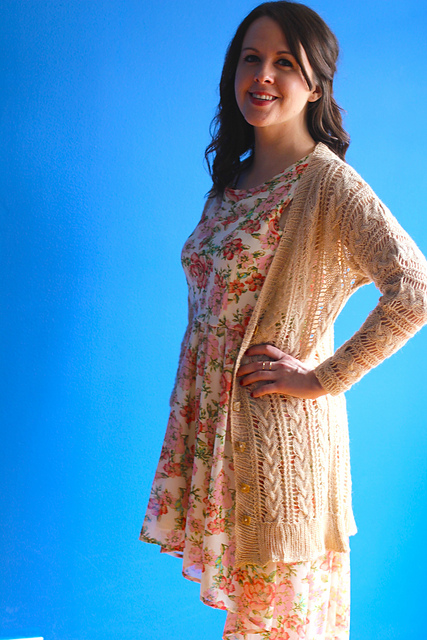
Cafe au Lait by Kristen Singer from Holla Knits
The Holla Knits Spring 2014 collection features five great patterns that are perfect for fashion forward knitters. As always, we're impressed with the creativity of the patterns in this issue of Holla Knits, and we're so pleased to be today's blog tour stop! While it's hard to choose a favorite pattern from this season's collection, we'd like to highlight the  Cafe au Lait cardigan by Kristen Singer today!

This beautiful cable and lace cardigan is knit at a loose gauge to give it airiness and beautiful drape. We think it would be perfect to wear with a dress (as shown here), but it would also look great with jeans and a t-shirt!

This is the perfect comfy cardigan that you can wear with just about anything in your wardrobe, no matter what time of year it is.

Be sure to visit all the stops on the Holla Knits Blog Tour!

April 8: The Sweatshop of Love Blog: SEG: Baah Yarns
April 11: Kirsten Singer: Pattern and Classic Elite Vale giveaway
April 15: Canary Knits: SEG: Skeinny Dipping skein of Cashmerino DK
April 16: Baah Yarns: I skein of Baah Yarns Shasta and a 1 skein cowl pattern
April 17: Knitter’s Pride Blog: Review and pattern giveaway
April 18: DovieJay Knits: SEG: I skein of Artisan Yarns Alpaca Silk
April 22: Mari Knits: Review and pattern giveaway
April 23: Magical Grammar: Review and pattern giveaway
April 24: Knit York City: Review and pattern giveaway
April 25: Under the Red Umbrella: Review and pattern giveaway

Giveaway

Enter our giveaway for a Knitter's Pride Bamboo Deluxe Interchangeable Needle Set. Click here to enter! We'll announce the winner on the blog on Friday, April 25, 2014.

Pattern Giveaway

Leave a comment on this blog post and tell us which of the new patterns from Holla Knits Spring 2014 is your favorite for your chance to win your favorite pattern! Please don't forget to leave your Ravelry ID so that we can contact you if you're the winner. We'll announce one winner on the blog on Friday, April 25, 2014.

Getting Over Your Fear Of Knitting Sweaters

This guest post is by Johnny Vasquez, co-creator of The 30 Day Sweater as part of the promotional tour for The 30 Day Sweater Challenge. To learn more about the challenge or to sign up, visit http://30daysweater.com/knitterspride.

My friend Sue has been knitting for more than 50 years. She’s made all kinds of things; hats, scarves, socks, mittens, blankets. But until recently she was always too scared to try knitting a sweater. Like many knitters, even though she had all the skills she needed, there was something keeping her from tackling her first sweater: Fear.

This may not be the kind of crippling fear I have when I see a snake or a tarantula (seriously, don’t ever put me near a tarantula. I’ll scream like a little girl and be halfway down the street in seconds), but there is definitely a mental block for some when it comes to knitting sweaters. They’re time-consuming, expensive, require lots of finishing, and have a lot of opportunity for error. Every knitter’s worst nightmare is to knit for days on end, only to find you’ve made an irreparable mistake and have to start over. But fear not! There is hope. Knitting a sweater does not have to be as hard as you think. Here are a few tips to help you get over your fear of knitting sweaters.

Guess What? You Probably Already Know Everything You Need To Knit A Sweater!
While knitting a sweater isn’t necessarily simple, there are only a few things you need to know:

1. How to cast on.
2. How to knit the knit stitch.
3. How to knit the purl stitch.
4. How to do a basic increase.
5. How to do a basic decrease.
6. How to bind off.

Now, you may be shaking your head, wondering why I didn’t include finishing, seaming, button bands and picking up stitches, etc.The answer is this: for a simple sweater, it’s possible to make one with only the 6 techniques listed above!

Many traditional-style sweaters require you to knit in pieces and sew them together - for many, this is terrifying or unappealing. There are lots of knitters who do not enjoy seaming for one reason or another! Luckily, not all sweaters have seams: my favorite way to knit a sweater is top-down, which has the advantage of being knit in the round, can be tried on as you go, and in most cases, is entirely seamless. There are a few methods for knitting sweater from the top down, but my favorite is the raglan.

Elephant pattern by Sandy Myerson
Eat The Elephant.
There’s a famous saying: “How do you eat an elephant? One bite at a time.” Take a look at your sweater pattern and break it down into smaller chunks. Map these little bites onto a calendar and plan out a schedule for knitting your sweater. Even if you don’t stay entirely on schedule, you can rest your mind by knowing you only need to finish a small part each day. These small sections will eventually lead you to a completed sweater and make it easier for you to finish.

Pushing Beyond Your Comfort Zone Helps You Become A Better Knitter.
All of us want to be better at our craft. But you’re only as good as the hardest thing you try. If you want be improve your knitting, you’ll need to make projects that are more advanced than you think you’re capable of. Remember, no matter how complicated a pattern may be, at the end of the day, it’s all knits and purls.

It's Only Knitting!
We’re not solving world hunger or curing cancer. We’re knitting sweaters. The pressure is off. So what if you have to rip out a sleeve? That’s ok! It’s not a race. There is no secret knitting society tracking your project, making sure that you’re worthy of joining their ranks . . . that we know of. Part of the fun of knitting is the journey. Those struggles are memories you’re creating that make that sweater even more meaningful. Every time you wear it, you’ll be reminded of the hard work you put in to create this work of art.


Conclusion:
There are a lot of things that are legitimately scary. Being dragged to the bottom of the ocean by a giant squid is scary. Raising kids is scary. Tarantulas are scary. Knitting? Not scary! Face your fears. Knit a sweater. If you’d like a little bit of help planning your next (or first) sweater project, check out our free sweater planning guide. It walks you through all the questions you’ll need to consider before making a sweater.

Click Here to Download

If you need a little bit of motivation to finish your sweater, take the 30 Day Sweater Challenge! Join thousands of knitters around the world as we knit a whole sweater during the month of October. We’ll have lots tips and tricks, interviews with industry experts, and special giveaways along the way. To learn more and sign up, visit http://30daysweater.com/knitterspride.